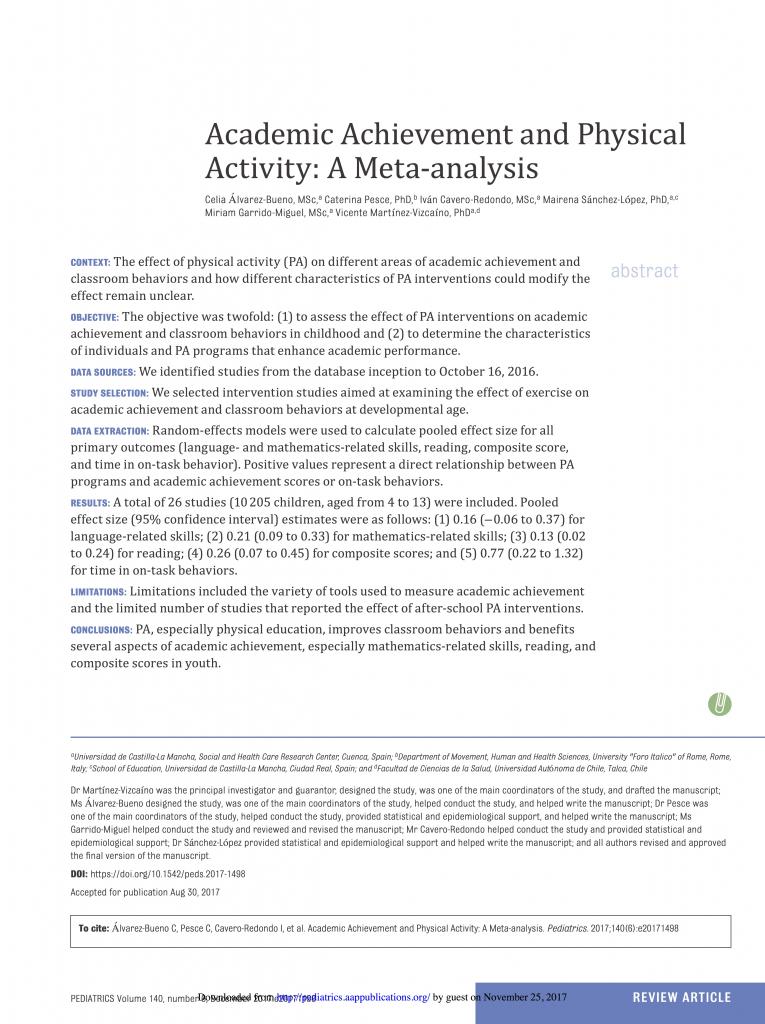
CONTEXT: The effect of physical activity (PA) on different areas of academic achievement and
classroom behaviors and how different characteristics of PA interventions could modify the
effect remain unclear.
OBJECTIVE: The objective was twofold: (1) to assess the effect of PA interventions on academic
achievement and classroom behaviors in childhood and (2) to determine the characteristics
of individuals and PA programs that enhance academic performance.
DATA SOURCES: We identified studies from the database inception to October 16, 2016.
STUDY SELECTION: We selected intervention studies aimed at examining the effect of exercise on
academic achievement and classroom behaviors at developmental age.
DATA EXTRACTION: Random-effects models were used to calculate pooled effect size for all
primary outcomes (language- and mathematics-related skills, reading, composite score,
and time in on-task behavior). Positive values represent a direct relationship between PA
programs and academic achievement scores or on-task behaviors.
RESULTS: A total of 26 studies (10 205 children, aged from 4 to 13) were included. Pooled
effect size (95% confidence interval) estimates were as follows: (1) 0.16 (−0.06 to 0.37) for
language-related skills; (2) 0.21 (0.09 to 0.33) for mathematics-related skills; (3) 0.13 (0.02
to 0.24) for reading; (4) 0.26 (0.07 to 0.45) for composite scores; and (5) 0.77 (0.22 to 1.32)
for time in on-task behaviors.
LIMITATIONS: Limitations included the variety of tools used to measure academic achievement
and the limited number of studies that reported the effect of after-school PA interventions.
CONCLUSIONS: PA, especially physical education, improves classroom behaviors and benefits
several aspects of academic achievement, especially mathematics-related skills, reading, and
composite scores in youth.
Publicaciones

- Academic Achievement and Physical Activity: A Meta-analysis
- Celia Álvarez-Bueno, Caterina Pesce, Iván Cavero-Redondo, Mairena Sánchez-López, Miriam Garrido-Miguel, Vicente Martínez-Vizcaíno
- Revista: PEDIATRICS
- Volumen: 140
- Editorial: American Academic of Pediatrics
- Año: 2017
- Número de páginas: e20171498