Abstract OBJECTIVE: Muscular fitness levels have been associated with cardiometabolic risk in children, although whether body weight acts as a confounder or as an intermediate variable in this relationship remains controversial. The aim of this study was to examine whether the association between muscular fitness and cardiometabolic risk factors is mediated by body mass index (BMI). DESIGN AND METHODS: Cross-sectional study using a sample of 1158 schoolchildren aged 8-11 years from the province of Cuenca, Spain. We measured anthropometrics and biochemical variables and we calculated a...
Publicaciones

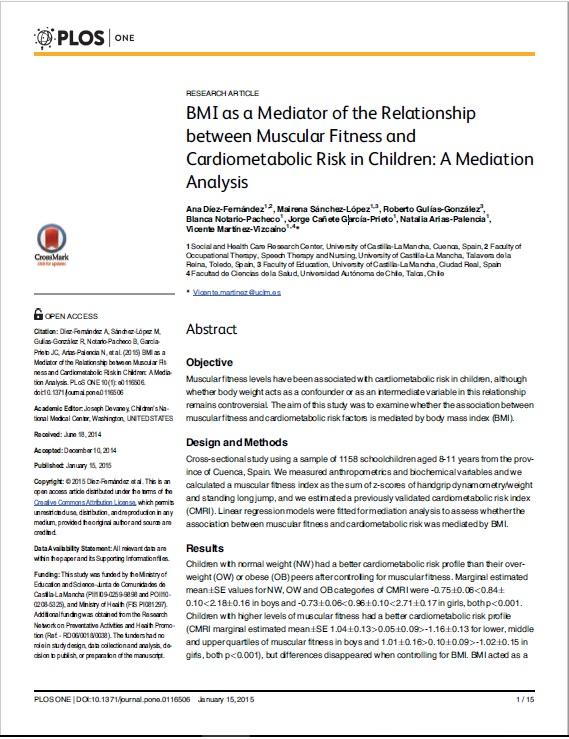
- BMI as a mediator of the relationship between muscular fitness and cardiometabolic risk in children: a mediation analysis.
- Ana Díez-Fernández, Mairena Sánchez-López, Roberto Gulías-González, Blanca Notario-Pacheco, Jorge Cañete García-Prieto, Natalia Arias-Palencia, V
- Revista: PLOSONE
- Volumen: 10(1)
- Año: 2015
- Número de páginas: e0116506
BMI as a mediator of the relationship between muscular fitness and cardiometabolic risk in children: a mediation analysis.
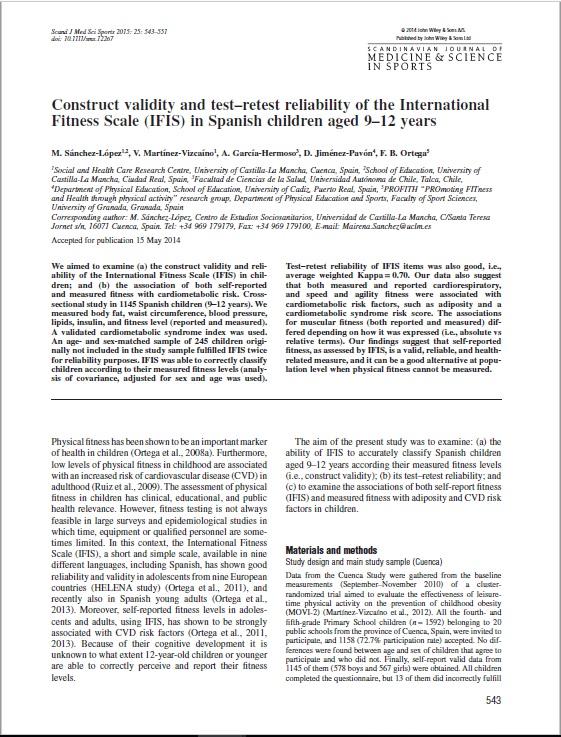
- Construct validity and test–retest reliability of the International Fitness Scale (IFIS) in Spanish children aged 9–12 years
- Sánchez-López M, Martínez-Vizcaíno V, García-Hermoso A, Jiménez-Pavón D, Ortega FB.
- Revista: Scandinavian Journal of Medicine and Science Sports
- Volumen: 25(4)
- Año: 2015
- Número de páginas: 543-551
Construct validity and test–retest reliability of the International Fitness Scale (IFIS) in Spanish children aged 9–12 years
Abstract We aimed to examine (a) the construct validity and reliability of the International Fitness Scale (IFIS) in children; and (b) the association of both self-reported and measured fitness with cardiometabolic risk. Cross-sectional study in 1145 Spanish children (9-12 years). We measured body fat, waist circumference, blood pressure, lipids, insulin, and fitness level (reported and measured). A validated cardiometabolic syndrome index was used. An age- and sex-matched sample of 245 children originally not included in the study sample fulfilled IFIS twice for reliability purposes....
- Effectiveness of school-based physical activity programmes on cardiorespiratory fitness in children: a meta-analysis of randomised controlled trials
- Diana P Pozuelo-Carrascosa, Antonio García-Hermoso, Celia Álvarez-Bueno, Mairena Sánchez-López, Vicente Martinez-Vizcaino
- Revista: BJSM
- Volumen: 0
- Editorial: BMJ
- Año: 2017
- Número de páginas: bjsports-2017-097600
Effectiveness of school-based physical activity programmes on cardiorespiratory fitness in children: a meta-analysis of randomised controlled trials
Objective: To conduct a meta-analysis of randomised controlled trials aimed at testing whether school-based physical activity programmes improve cardiorespiratory fitness (CRF) in children. Design: Systematic review with meta-analysis. Data sources: Using keywords, we performed a computerised search in five databases: MEDLINE, EMBASE, CINAHL, Web of Science and SportDiscus. Eligibility criteria for selecting studies: Studies that assessed the effectiveness of school-based physical activity programmes on improving CRF in children (3–12 years old). We selected interventions that included an...
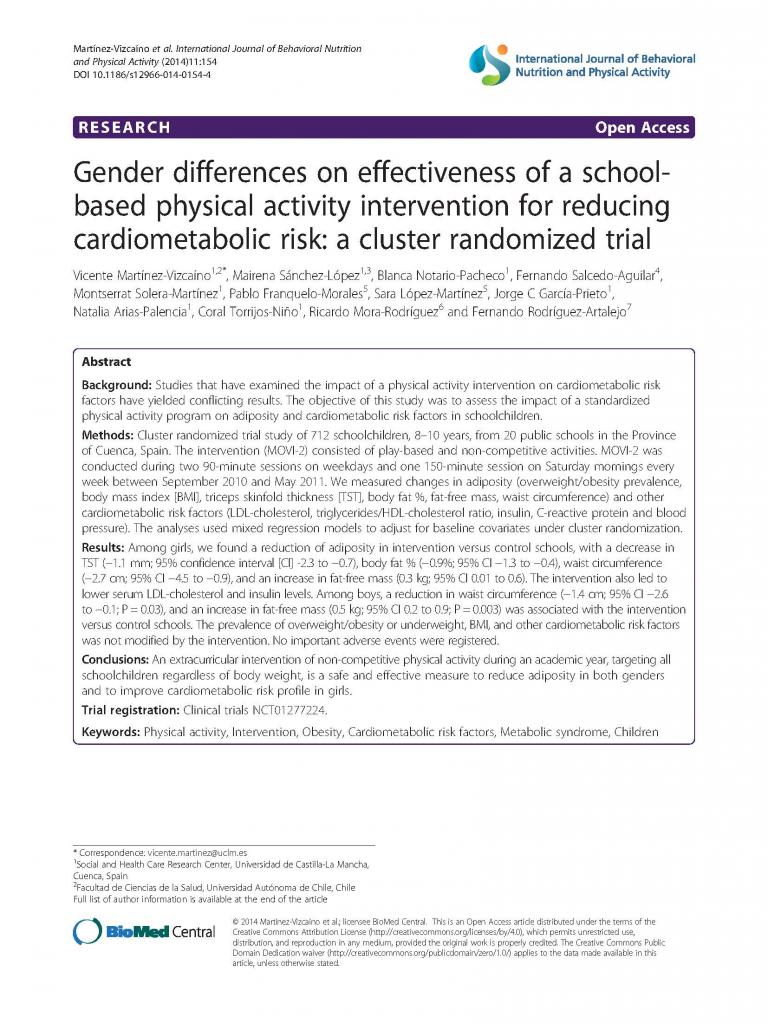
- Gender differences on effectiveness of a schoolbased physical activity intervention for reducing cardiometabolic risk: a cluster randomized trial
- Vicente Martínez-Vizcaíno, Mairena Sánchez-López, Blanca Notario-Pacheco, Fernando Salcedo-Aguilar, Montserrat Solera-Martínez, Pablo Franquelo-Morales, Sara López-Martínez, Jorge Cañete García-Prieto, Natalia Arias-Palencia, Coral Torrijos-Niño, Ricardo Mora-Rodríguez, Fernando Rodríguez-Artalejo
- Revista: International Journal of Behavioral Nutrition
- Volumen: 11
- Año: 2014
- Número de páginas: 154
Gender differences on effectiveness of a schoolbased physical activity intervention for reducing cardiometabolic risk: a cluster randomized trial
Abstract Background Studies that have examined the impact of a physical activity intervention on cardiometabolic risk factors have yielded conflicting results. The objective of this study was to assess the impact of a standardized physical activity program on adiposity and cardiometabolic risk factors in schoolchildren. Methods Cluster randomized trial study of 712 schoolchildren, 8–10 years, from 20 public schools in the Province of Cuenca, Spain. The intervention (MOVI-2) consisted of play-based and non-competitive activities. MOVI-2 was conducted during two 90-minute sessions on...